As Algorithms Becoming Intelligent, We May Become Unintelligent

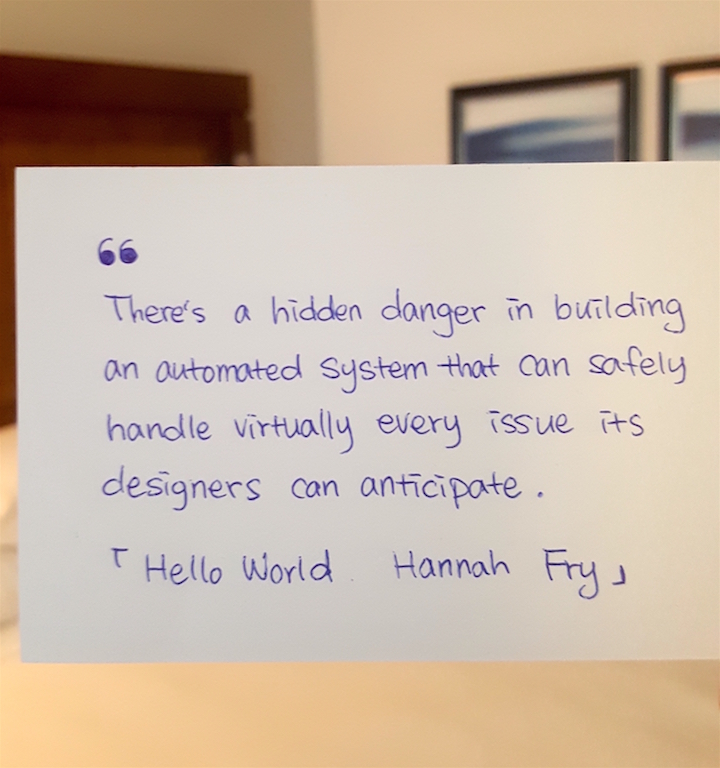
“There’s a hidden danger in building an automated system that can safely handle virtually every issue its designers can anticipate. (…) So they’ll have very little experience to draw on to meet the challenge of an unanticipated emergency.”

[Hello World: Being Human in the Age of Algorithm, Hannah Fry]

Using Google Maps, I was driving to Quebec in Canada from my home (in the U.S.) for late summer vacation with my family. Just after passing the border, I realized that my phone did not work and of course Google Maps lost their power, too. I made a desperate attempt to drive with only road signs as my dad did. Our world is fast becoming intelligent via recent developments in smart devices, algorithms, automated systems, and AI. We don’t need to remember our friends’ phone numbers and physical addresses anymore. Moreover, we don’t need to memorize the exact spelling of the longer word; Google search can show the correct results from the misspelling. Can we say that we (not the world) are becoming intelligent?

Large autonomous systems will be widespread inevitably. For example, autonomous cars will be popular in the near future. So, the next generation may not know (or experience) how to correct a slide on an icy road. This lack of experience may lead to a nasty accident when the autonomous system is not working. Technologies do more, we do less (e.g. thinking or experience). However, there are two sides to every story. Since the invention of the calculator (or the computer), we have developed new research fields such as numerical analysis, scientific computing, or computational biology, resulting in the enormous expansion of knowledge. I hope that the advent of the large autonomous system provides not only the answer to problems we are facing now but also the vision for the better future.
Can Artificial Intelligence Be the New Judge in the Future?

hello world justice

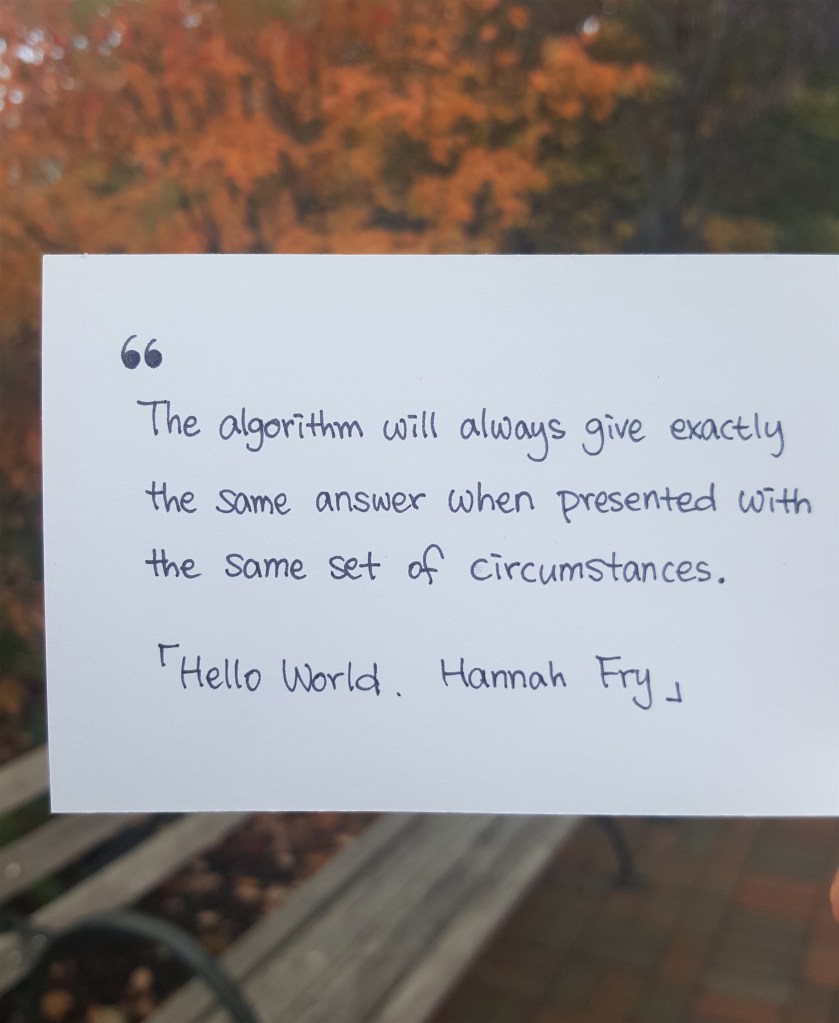
“The algorithm will always give exactly the same answer when presented with the same set of circumstances. (…). There is another key advantage: the algorithm also makes much better predictions.”

[Hello World: Being Human in the Age of Algorithm, Hannah Fry]

When we consider the dark side of algorithms and AI models, we always think about justice; The AI model is usually optimized for efficiency and profitability, not for justice (also see my previous post: Justice: What’s the Right Thing to Do in Data Science?). What is justice, by the way? Justice is the quality of being just or fair. Then what is “just” or “fair”? Defining the word “justice” or “just” is still an arguable issue in our society. In a slightly different context, we may say about “fair” instead. Fairness, in a narrow sense, requires consistency; The same input should produce the same output. For example, if you and I write down the same answer on the test, we should get the same score. That is the starting point to discuss fairness.

The (AI) algorithms which encapsulate detailed mathematical formulas have such fairness inherently, leading to a consistent consequence (the same input, same output). This is a big advantage of the algorithm for finding someone’s guilty consistently. Furthermore, the prediction is much accurate than human’s prediction. However, the consistency may also occur consistent error until the algorithm is adjusted. Humans, on the other hand, have their own models in their minds to judge someone’s guilty. However, this is not based on mathematics (or rigorous reasoning), leading to inconsistent outcomes for the same circumstances. Also, it is really hard to correct their bias and prejudice while the algorithm is easy to adjust their parameters for correction. Then who is more righteous in terms of fairness? 

Digging Data in the New Wild West

hello world data power

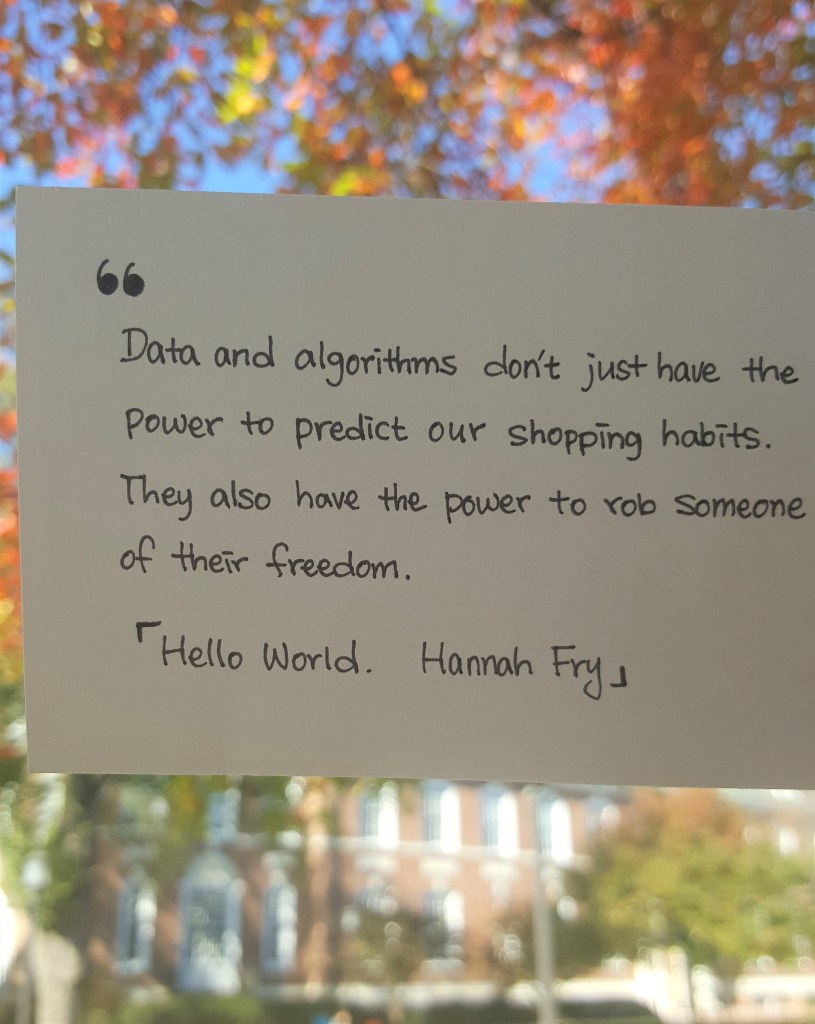
“We do well to remember that there’s no such thing as a free lunch. (…). Data and algorithms don’t just have the power to predict our shopping habits. They also have the power to rob someone of their freedom”

[Hello World: Being Human in the Age of Algorithm, Hannah Fry]

There are many FREE apps for tracking your routine such as walking, jogging, eating, book reading, shopping, or studying. Thanks to these productive apps, we can check our daily routine and change our routine for better performance. By the way, how do these free apps make money? There is no free lunch in the world. They make their profit from the data you recorded. In the age of Big Data, data is the new gold and many companies are digging such gold in our daily routines now. We might say we live in the new Wild West.

Someone might think that Data is just Data. That is true but the AI model can spot important (hidden) patterns from massive data effectively. They can dig gold in the mine by efficient tools. Moreover, they make precise categories for people’s behaviors, leading to an accurate prediction (classification) for new customers. Hence, AI models are becoming more sophisticated as increasing the number of data they collect. Amazon and other online retailers provide irresistible deals and coupons every day. Netflix and other streaming services recommend the best movies we will like so we cannot help clicking the next movie. In these days, we cannot blame a shopaholic. because (internet) shopping addiction is not caused by a lack of self-control but caused by a sophisticated AI model. That is why I purchase more books on Amazon today (Don’t blame me!).

Who Is our Future AI and What Is our Role?

hello world algorithm

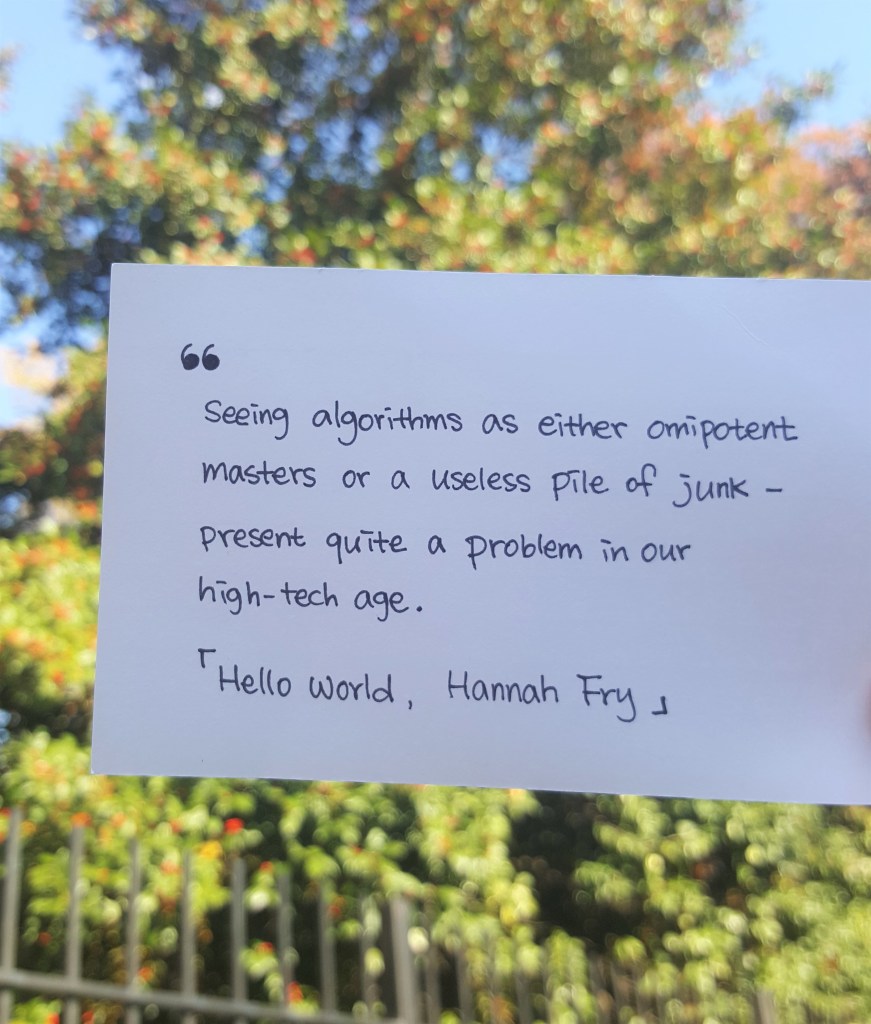
“This tendency of ours to view things in black and white – seeing algorithms as either omnipotent masters or a useless pile of junk – present quite a problem in our high-tech age.”

[Hello World: Being Human in the Age of Algorithm, Hannah Fry]

In the famous marvel movie, “Avengers: Age of Ultron”, Two different AIs appeared. The first one is JARVIS (Just A Rather Very Intelligent System) that helps the Iron man – Good AI. Another one is Ultron, the AI supervillain, to destroy the world like “Skynet” in Terminator – Bad AI. Who (or what) will be in our future world? It is hard to answer this question. A lot of books written by AI experts are divided into two forecasts; AI utopia and AI dystopia. However, all the books speak with one voice that the future of AI depends on our actions. Hence, we don’t need to forecast our future in black and white. The (real) future of AI, I believe, will be in between and will be adjustable by us.

Artificial Intelligence is a system consisting of mathematical algorithms to take action that maximizes the probability of success for the given task. It is just (complicated but) a set of algorithms, not a supernatural power. That is, there is still room for understanding it and making it good. First, we should reaffirm fundamental mathematics inside of the AI algorithm as many as we can and eliminate hidden mathematical errors (or computer bugs). Second, we feed them to unbiased and correct data so that AI makes an impartial model to decide their actions. Third, we need to set clear and socially approved objectives for AI models. The first two actions are relatively practicable but the last part requires a social consensus to make a good AI model. For example, the United Nations platform, AI for Good, has tried to offer a route for sustainable development goals. So, please think about the future of AI and about your roles for making a good AIs.