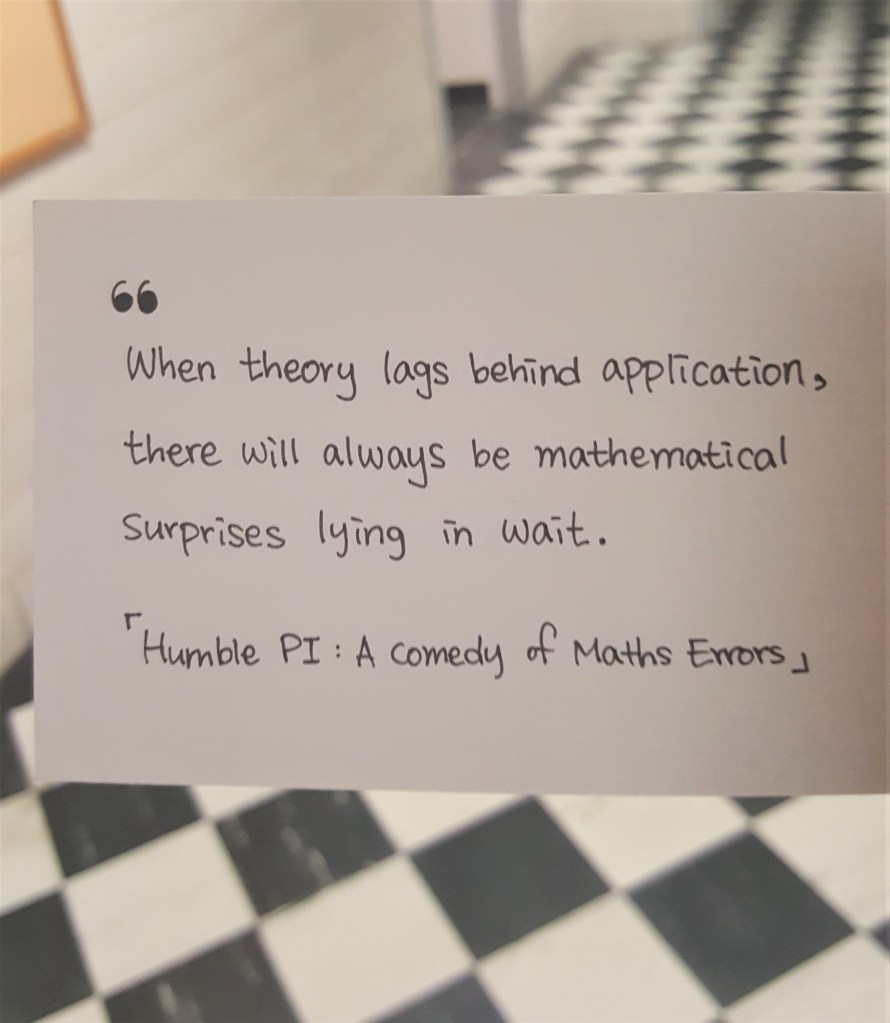
“We make things beyond what we understand, and we always have done. … When theory lags behind application, there will always be mathematical surprises lying in wait.”
[Humble PI: A Comedy of Maths Errors, Matt Parker]
In human history (specifically engineering and technology), many successful achievements have shown their effectiveness without proven scientific theories or rigorous mathematics. For example, first flying to the moon in 1969 was achieved with little knowledge of rocket science, aerodynamics, and astrophysics. Sometimes, we called such achievements “the greatest challenge for humans.” However, the word “challenge” here implies that we do not know a mechanism or theory well. I don’t want to underestimate such a challenge but we have experienced that applications without coherent theories may lead to a catastrophic disaster.
Then, in data science, when is the right time to adopt a new model? Should we wait until we understand all theories and mechanisms and prove them all by mathematics? It may be too late. So we should decide the right time by ourselves but we always keep in mind the negative effect when the introduced model fails. So, we try to quantify uncertainties of the model (or our decision) and estimate a probable disaster as insurance companies do. It is much robust thinking rather than efficient thinking. It may lead to slow progress and more cost but it can give us a second chance to correct the model when the model fails. So, if you don’t have rigorous mathematical support, please think uncertainty and make your model robust. Moreover, when you decide something without evidence in your life, please make your decision robust, too.

 Everybody makes DATA