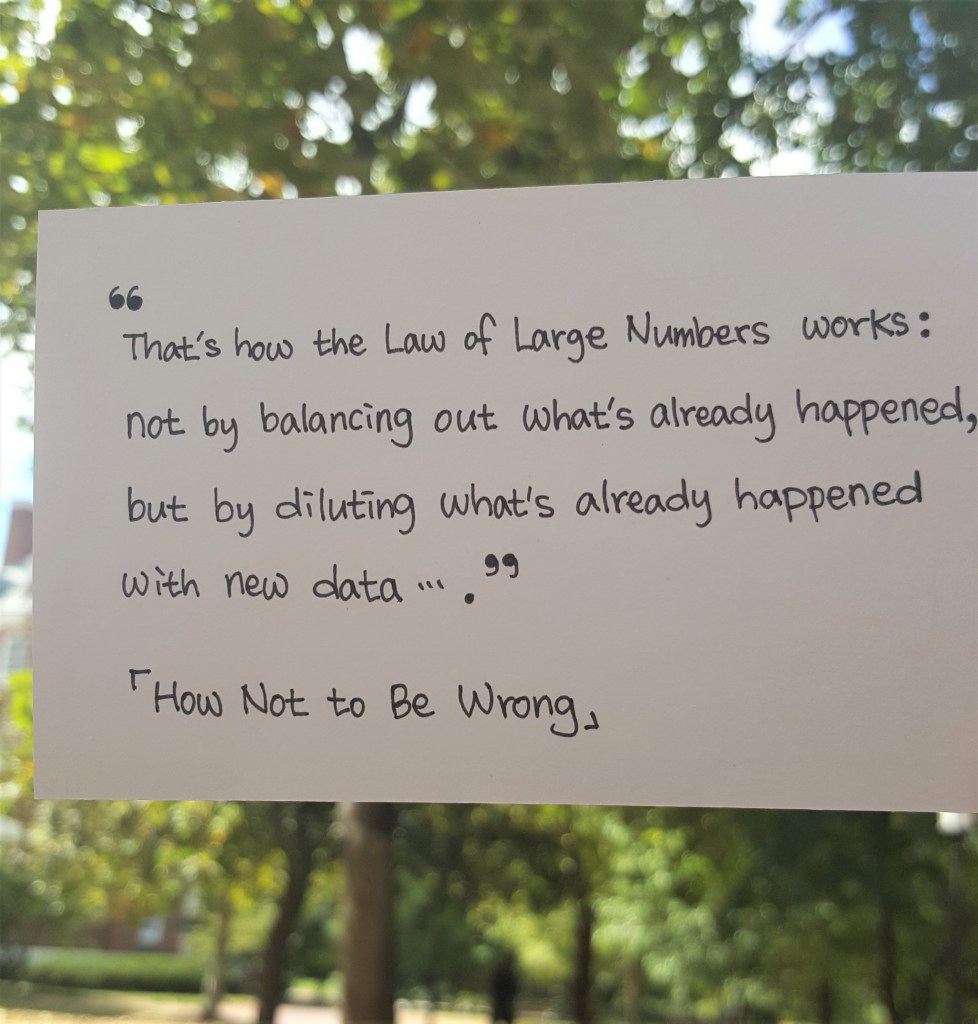
“That’s how the Law of Large Numbers works: not by balancing out what’s already happened, but by diluting what’s already happened with new data, until the past is so proportionally negligible that it can safely be forgotten.”
[How not to be wrong, Jordan Ellenberg]
You have a FAIR coin and toss it ten times. Surprisingly, ten heads in a row! Now, you should bet on head or tail. Where do you put your money? Fortunately, you had learned the law of large numbers which said that the average of large trials closer to the expected value. So, the next will be “tail” for balancing out by this law. BUT, it is not true, the probability of getting head or tail is still the same. We called this misconception as “Gambler’s Fallacy”. The law of large numbers CANNOT predict your future.
We often misunderstand that the previous independent results are highly related to the future result. Before you think like that, you should check first that previous results are really related to my future decision. If not, please forget about the past. Please don’t make the wrong causality using the law of large numbers. Even though you see that the average of repeated trials is far from normal, it cannot say anything about the future. Queen Elsa in Frozen says “Past is in the past” in her famous song ‘Let it go’.

 Everybody makes DATA