What Number Is a Really Big Number?

humble pi

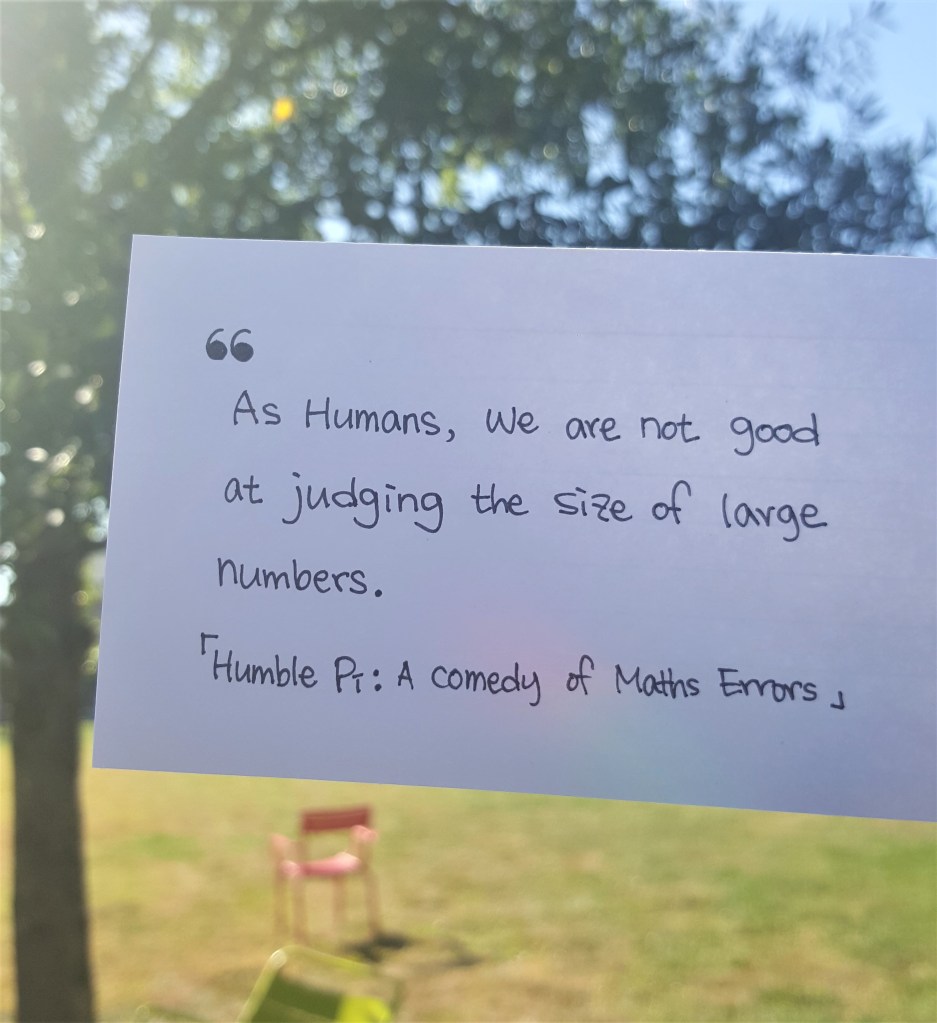
“As humans, we are not good at judging the size of large numbers. And even when we know one is bigger than another, we don’t appreciate the size of the difference.”

[Humble Pi: A Comedy of Maths Errors, Matt Parker]

In the Stone Age, a hundred might be a sufficient number to count a herd of deer for hunting or to count gathered nuts. In the early (and mid) 20th century, a million is enough to call the rich people ‘Millionaire’ but now it is too small to count Mark Zuckerberg’s net worth (a million is still BIG money for me by-the-way). In the age of Big Data, what number is a really big number? In the 1980s, Bill Gates, the pioneer to usher in the computer age, said: “for computer memory, 640K ought to be enough for anybody.” Nobody can predict the big number correctly and this is human nature. 

However, we need to estimate a certain big number for a data-driven model, for our business, or for our blogs. After unveiling a smartphone, data acquisition speed is now super fast, leading to the age of AI and Big Data. Nowadays, when we make a model, we consider its own capacity to deal with tremendous data (beyond a trillion). The recent introduction of the Internet of Things (IoT) and the autonomous vehicle will generate countless data every second. Then, we need to keep thinking about the big number again and again. That is why I am preparing for the first event for the Billionth visitor to my blog. Do you think this number is still small? It depends on your action. please visit my blog more! 
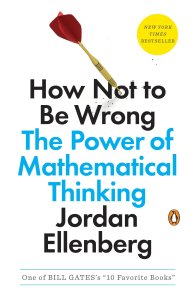
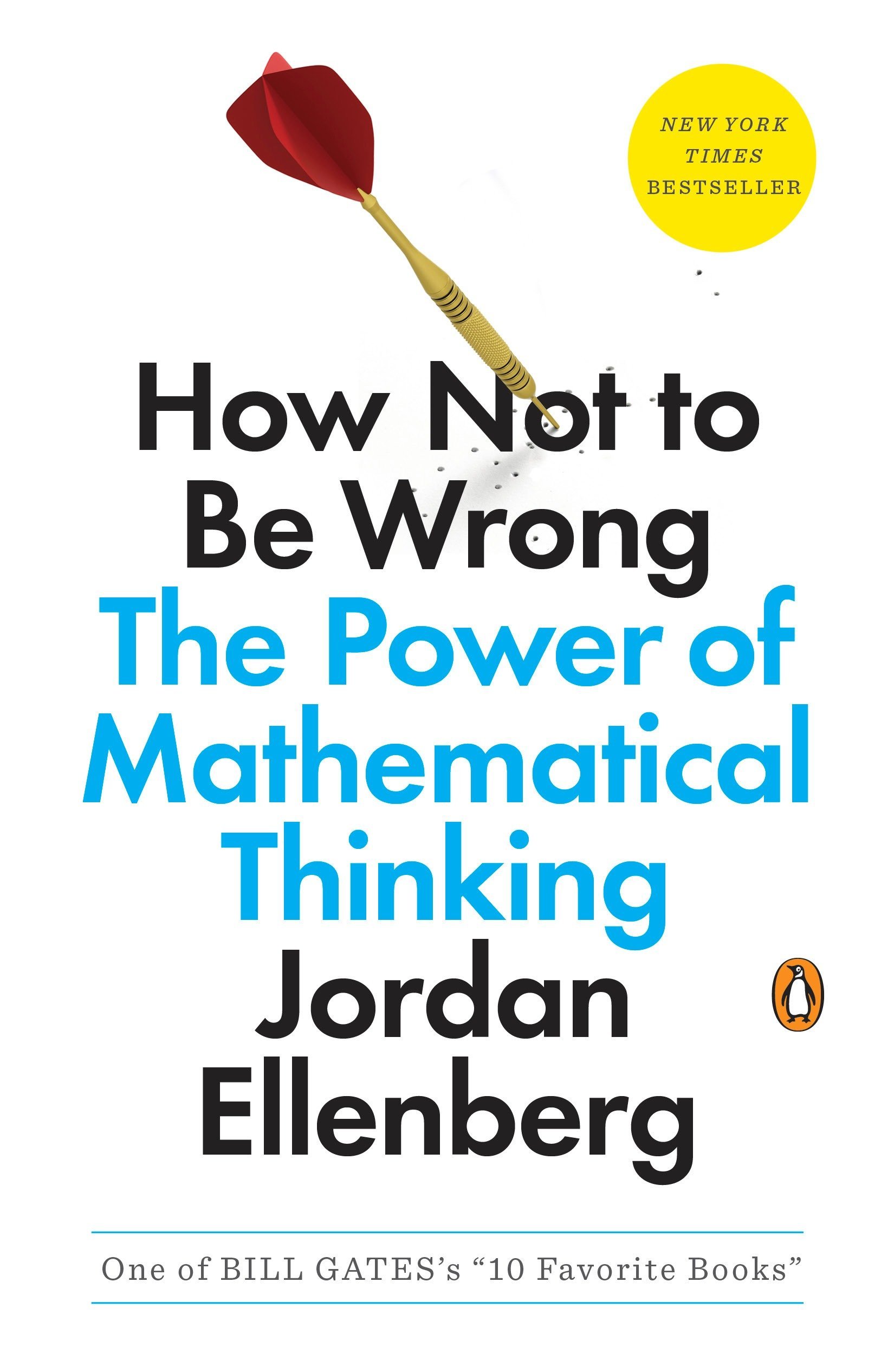
[Wrap up] Book Review: How Not to Be Wrong: The Power of Mathematical Thinking

We need to focus on the book title: How not to be wrong. Why did the author, Jordan Ellenberg, not say like: How to be right? This is because mathematical thinking is not the fruit of the Tree of Knowledge. Even though we equipped ourselves with concrete mathematical thinking, we cannot get the right answer to some problems we faced in the world. However, mathematical thinking helps us to correct our view based on a popular misconception and prejudice and to understand the structure of the world more clearly.

In this book, the author presents several mathematical misconceptions (more focused on statistics) that make the wrong decision and prediction, and show how mathematical thinking can overcome such kinds of obstacles. Since mathematical thinking is the extension of common sense by other means, the author said that we need more math majors for non-mathematician such as more math majors for non-mathematician such as math major doctors, high school teachers, CEOs, and politicians.

The following links are some quotations from the book with my thoughts.

(1) Do You Want to Be a Nonlinear Thinker?

(2) The Past is in the Past: the Law of Large Numbers

(3) Improbable Things Happen All the Time

(4) Can We Predict our Future in Chaos?

(5) Make Your Problem Harder!

(6) The Triumph of Mediocrity: Do not Stumble on Your Success

(7) Everything is Connected but Not Correlated

(8) When You Meet a Mathematical Genius

When You Meet a Mathematical Genius

how not to be wrong

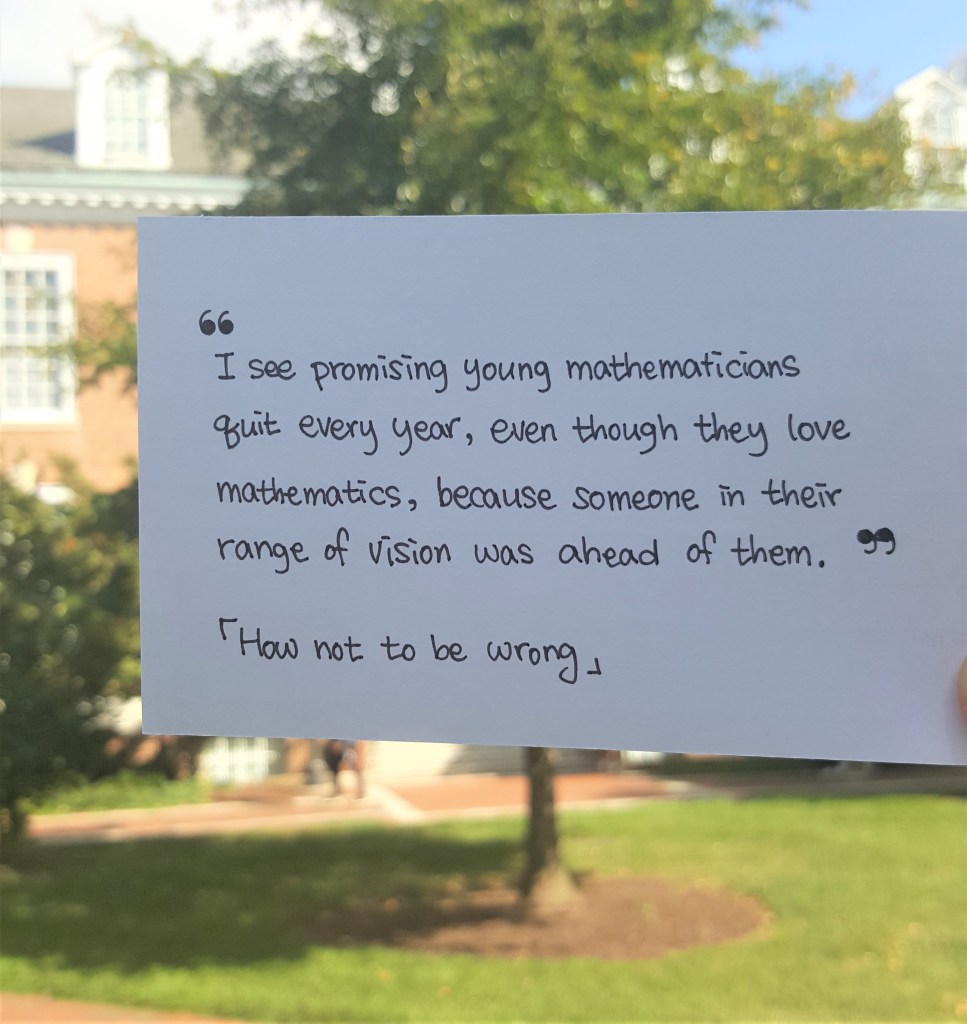
“Athletes don’t quit their sport just because one of their teammates outshines them. And yet I see promising young mathematicians quit every year, even though they love mathematics, because someone in their range of vision was ahead of them.”

[How not to be wrong, Jordan Ellenberg]

I know this is a little bit off the topic (and the style) of this blog but I would like to write this post for kids/students who want to be a future mathematician. In my life, I have met several mathematical geniuses equipped with complete mathematical skill sets, intuition, reasoning, and creativity. Many people may think that geniuses are not willing to work hard but all the geniuses I met before put their whole energy into solving some mathematical problems always. Hence, when I had met them, I had felt that there is NO chance to defeat such kinds of geniuses and had felt depressed every single day. Many prodigious kids/students give up chasing their dream to become a great mathematician like this way.

However, doing mathematics is not a race and competition to choose the only one winner. It is more like team sports. For example, in Football, the Quarterback looks like the one and only hero to win the game but it is not true. There are many unsung heroes to try to get a score and win the game. Likewise, the development of mathematics is not the exclusive property of the math geniuses. I don’t want to underestimate the role of math geniuses; they always give us a new point of view about mathematical thinking. But rather, I would like to redound to many roles of other mathematicians such as building rigorous mathematical formulation from brilliant ideas and applying this mathematical concept to various problems in the real world. Hence, “Genius” may represent not a person but a team (or generation).

So, here is my humble advice when you meet mathematical geniuses in your life:
(1) Do not compare yourself to them (everybody has an important role in developing mathematics).
(2) Learn everything from them as much as you can.
(3) Put your whole energy into developing, extending, and applying their brilliant idea.
(4) Do not give up.
(5) Be grateful for being contemporaneous with the great geniuses.

The Triumph of Mediocrity: Do not Stumble on Your Success

Triumph of Mediocrity

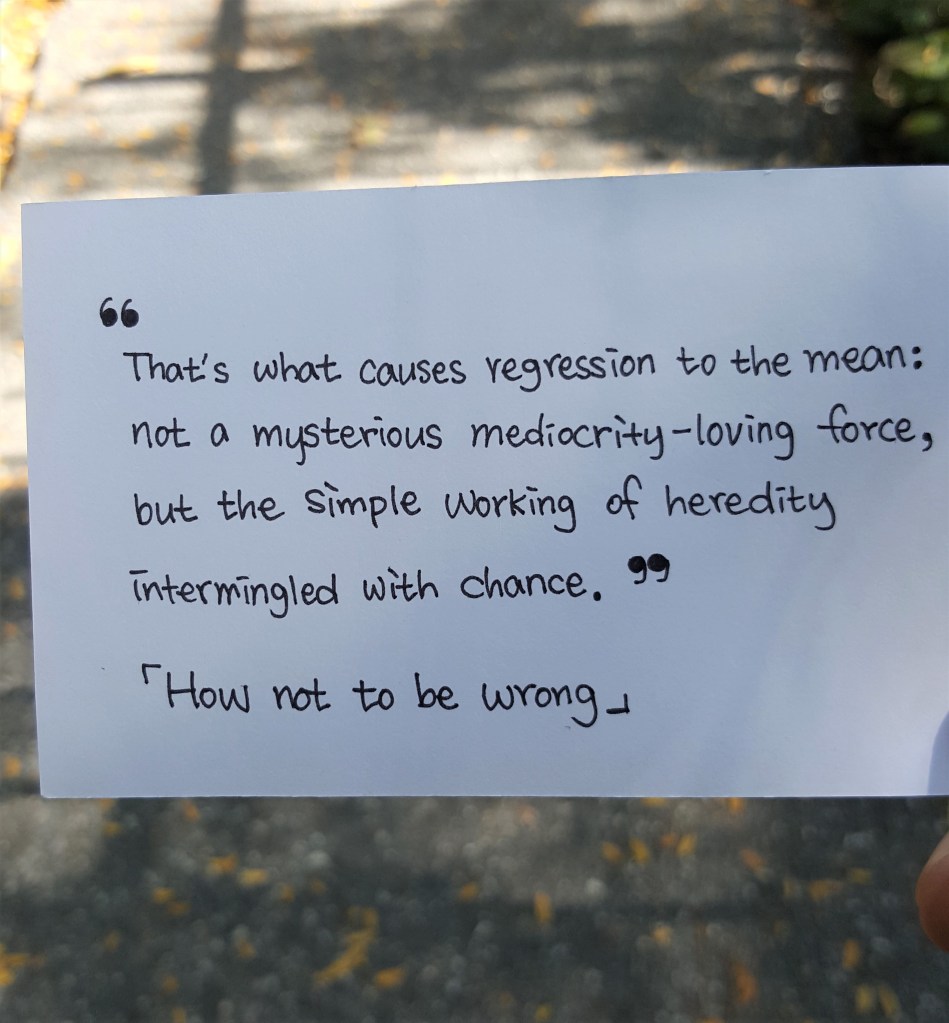
“That’s what causes regression to the mean: not a mysterious mediocrity-loving force, but the simple working of heredity intermingled with chance.”

[How not to be wrong, Jordan Ellenberg]

At the beginning of the month, I check the number of visitors and views on my blog and say: “What? Too many people come in! Then, my blog is ON PACE to break my monthly record!!” I am really excited about this shock rise. At the end of the month, my eyes widen in surprise because the average number of people visited, no new record (Sigh). This shows “The Triumph of Mediocrity.” Some data intertwined with deterministic factors and uncertainties show a tendency to regress to the mean.

This simple mathematical observation gives a lesson about how to live. There is no (deterministic) equation of success. Even if it exists, it has too many uncertainties so we cannot solve this equation. When you achieved something that you want, this success does not only stem from your skills, abilities, intelligence, and effort. Rather, uncertainties (many people call this “luck”) may drive your way to success. Just when you think that you find the equation of the success, your next try may fail and you will be back to the mean – we call this “Sophomore Slump.” So please be humble. please do not stumble on your success. Also, if you did your best but failed, please try one more, the triumph of mediocrity may take you to the success.

Make Your Problem Harder!

How not to be wrong

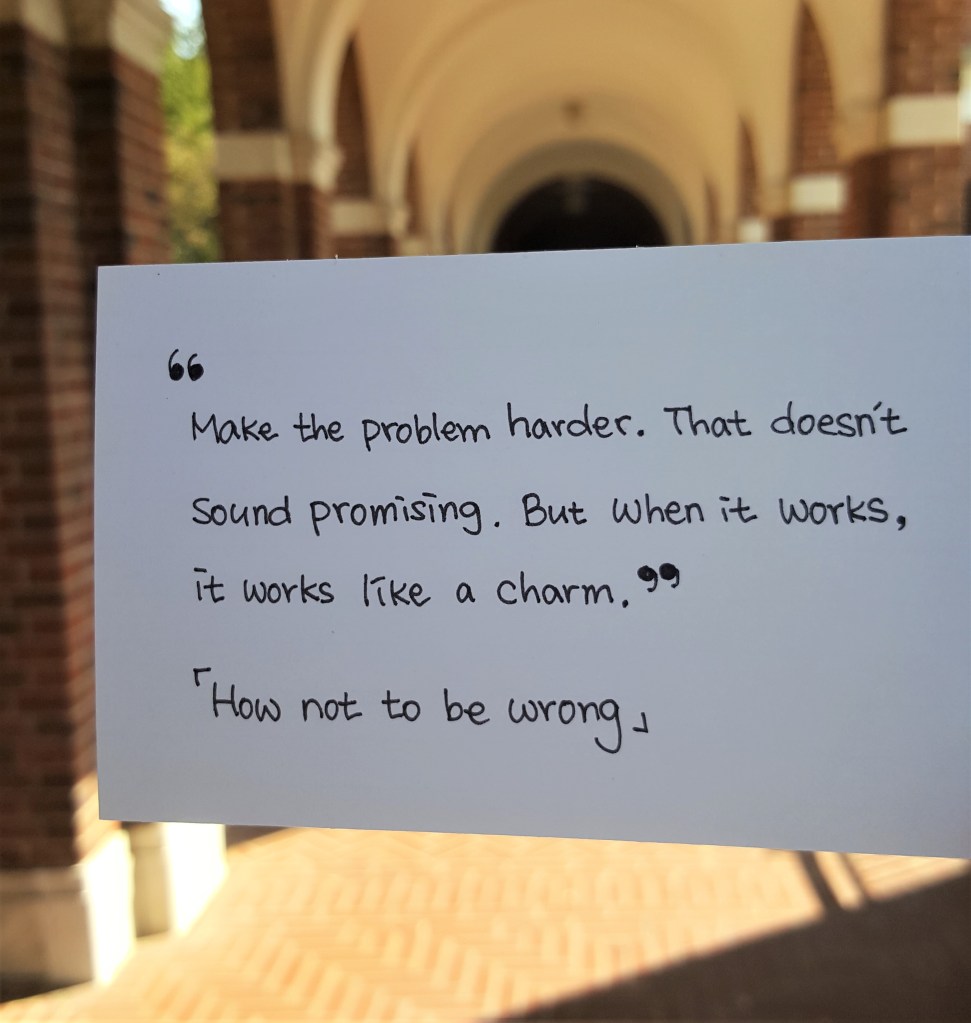
“Instead, we turn to the other strategy, which is the one Birbier used: make the problem harder. That doesn’t sound promising. But when it works, it works like a charm.”

[How not to be wrong, Jordan Ellenberg]

When your friend was struggling with a difficult problem, we often said: “Don’t make it complex, just start with a simple problem”. This is because we have experienced that this simplification provides some clues for solving the difficult problem. This is what mathematicians actually do every day. When proving some statements, they start from the simplest case and expand it to the target problem. However, sometimes, making the problem harder suggests a simple alternative way to solve your real problems effectively.

Many data scientists have focused only on reducing the number of features to make a data-driven model simper. However, this approach does not always give the simplest model. The projection onto the low-dimension (fewer features) may make the data structure more complicated, leading to a failure of spotting the hidden pattern. Hence, sometimes, they need to increase features to make a model simpler (because of more data, more simple). This alternative thinking (adding more features) embodies the trade-off between a simpler model with many features and a complicated model with few features.

Improbable Things Happen All the Time

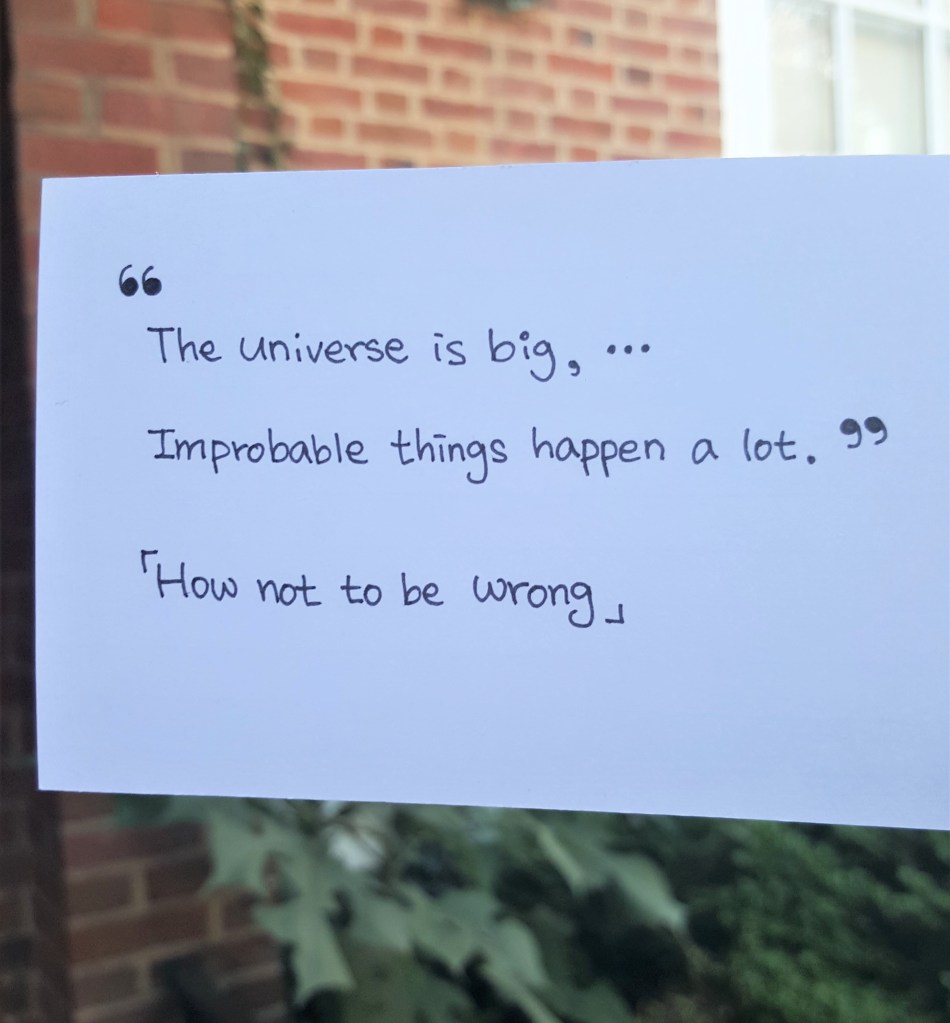
“The universe is big, and if you’re sufficiently attuned to amazingly improbable occurrences, you’ll find them. Improbable things happen a lot.”

[How not to be wrong, Jordan Ellenberg]

You have a card deck and draw five cards from this. Surprisingly, five cards you drawn are spade A, 2, 3, 4, and 5. (Congrats! you made a straight flush). Then, you might think that this is a new card deck so it is not shuffled yet because drawing these five cards in a row might be improbable (or much lower probable). However, improbable things happen all the time. Please go to Las Vegas and check this!

When analyzing some results, we need to get used to a BIG number in our fields. Our field of interest is pretty big and you can see many improbable occurrences (we can see winners of the lottery every week). Hence, we should be careful not to make any causality from a chance occurrence. In data science, even though the data-driven model finds some patterns from Big Data, we should examine that this pattern can be made by randomness or not. (It may be improbable that millions of people read this post and like it but improbable things happen all the time!!)

The Past is in the Past: the Law of Large Numbers

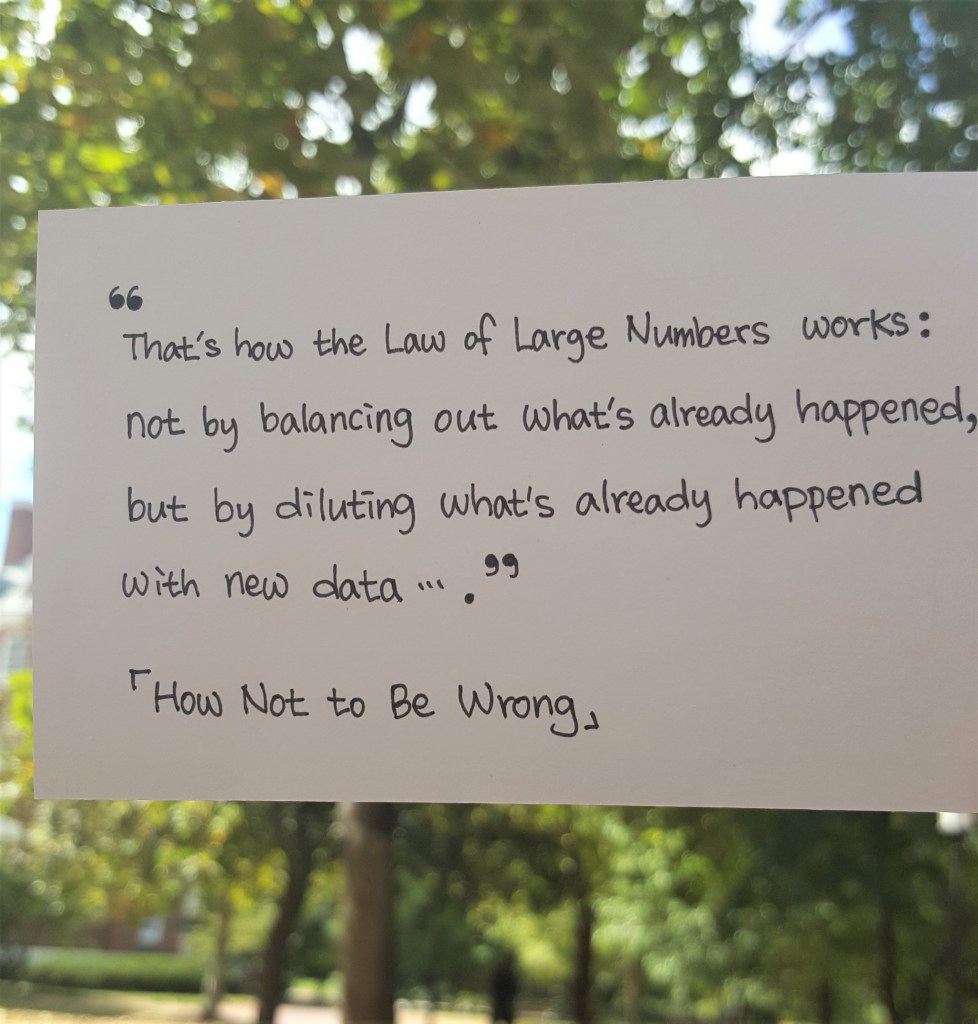
“That’s how the Law of Large Numbers works: not by balancing out what’s already happened, but by diluting what’s already happened with new data, until the past is so proportionally negligible that it can safely be forgotten.”

[How not to be wrong, Jordan Ellenberg]

You have a FAIR coin and toss it ten times. Surprisingly, ten heads in a row! Now, you should bet on head or tail. Where do you put your money? Fortunately, you had learned the law of large numbers which said that the average of large trials closer to the expected value. So, the next will be “tail” for balancing out by this law. BUT, it is not true, the probability of getting head or tail is still the same. We called this misconception as “Gambler’s Fallacy”. The law of large numbers CANNOT predict your future.

We often misunderstand that the previous independent results are highly related to the future result. Before you think like that, you should check first that previous results are really related to my future decision. If not, please forget about the past. Please don’t make the wrong causality using the law of large numbers. Even though you see that the average of repeated trials is far from normal, it cannot say anything about the future. Queen Elsa in Frozen says “Past is in the past” in her famous song ‘Let it go’.

Do You Want to Be a Nonlinear Thinker?

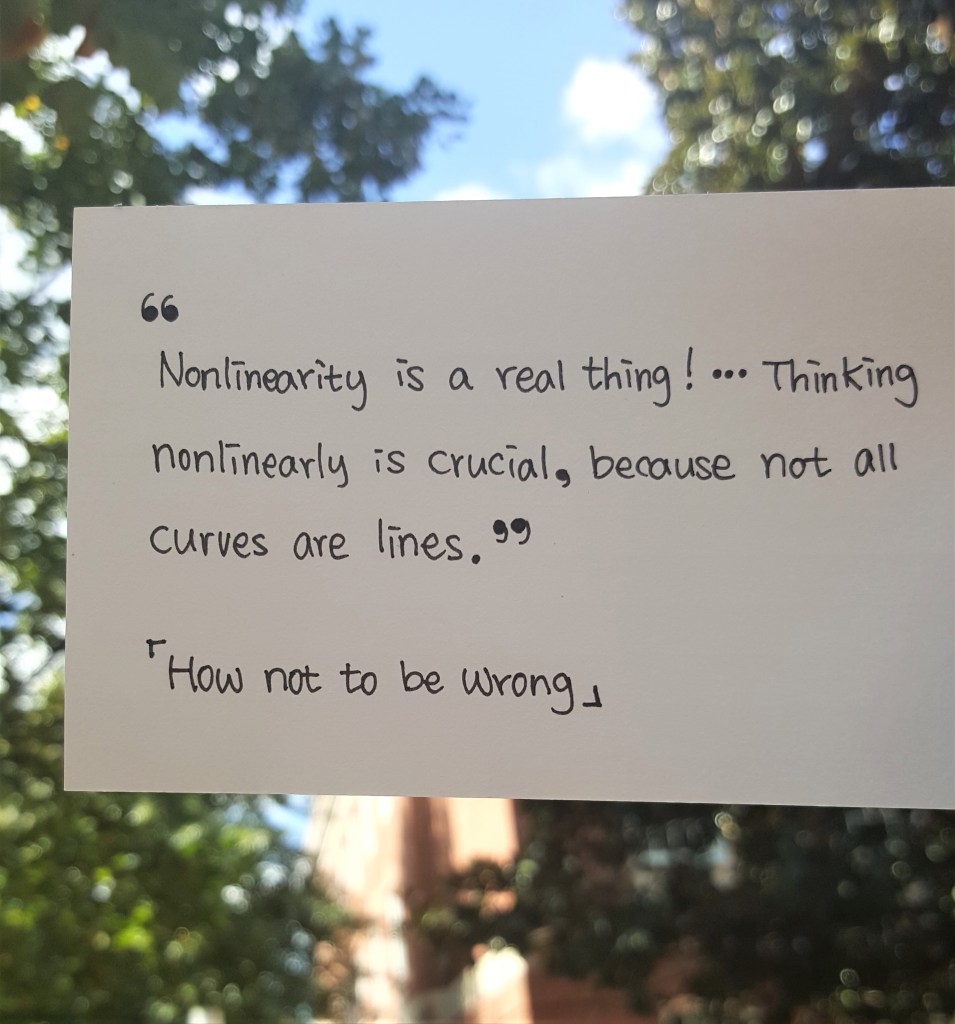
“Nonlinearity is a real thing! … Thinking nonlinearly is crucial, because not all curves are lines.”

[How not to be wrong, Jordan Ellenberg]

Many people want to be a nonlinear thinker who does not follow the step-by-step progression but tries to find the solution outside of the box. Hence, the word ‘nonlinear thinking’ implies somewhat special ability but most of the curves are nonlinear (only a few are lines) in the real world. That is, becoming a nonlinear thinker means (maybe) being mediocre.

When predicting future behaviors from the past (like the predictive model in AI), we should keep in mind that almost all curves are not lines. We should consider all possibilities to make our prediction nonlinear. Moreover, if our case turns out the nonlinear prediction, our optimal decision depends on where we already lie on the nonlinear curve. However, a linear prediction gives us good advantages to quickly find the pattern from the past and efficiently predict the (near) future behaviors because ALL curves seem to be lines locally. Hence, the balance of linear and nonlinear thinking is highly required in the age of Big Data.