[Wrap up] Book Review: Humble PI: A Comedy of Maths Errors

In our life, mathematics is very important for logical thinking based on evidence-based knowledge through rigorous mathematical analysis. Especially, when we predict something new, the power of mathematics overwhelms our instinct or heuristics. However, when using mathematics improperly, catastrophic results are waiting for us. In this book, the author, Matt Parker, said such an important role of mathematics and showed examples of disasters stemming from mathematical errors through exhilarating stories he has experienced. 

Then, what is the role of a human in mathematics? We try to use mathematics when deciding something important. And then, we should check all the types of mathematical errors to avoid the disaster. I would like to introduce his last paragraph. “Our modern world depends on mathematics and, when things go wrong, it should serve as a sobering reminder that we need to keep an eye on the hot cheese but also remind us of all the maths which works faultlessly around us.”

The following links are some quotations from the book with my thoughts.

(1) What Number Is a Really Big Number?

(2) Please Give Math More Time to Pick up the Pieces

(3) I Don’t Count on You When You Count Numbers

(4) More Approximations, More Problems in Your Life

(5) Probably, We Are Not Independent

(6) Searching for Average Man

(7) Sometimes, Simple Mathematics is Better than Our Experiences
Sometimes, Simple Mathematics is Better than Our Experiences
humble pi simple math

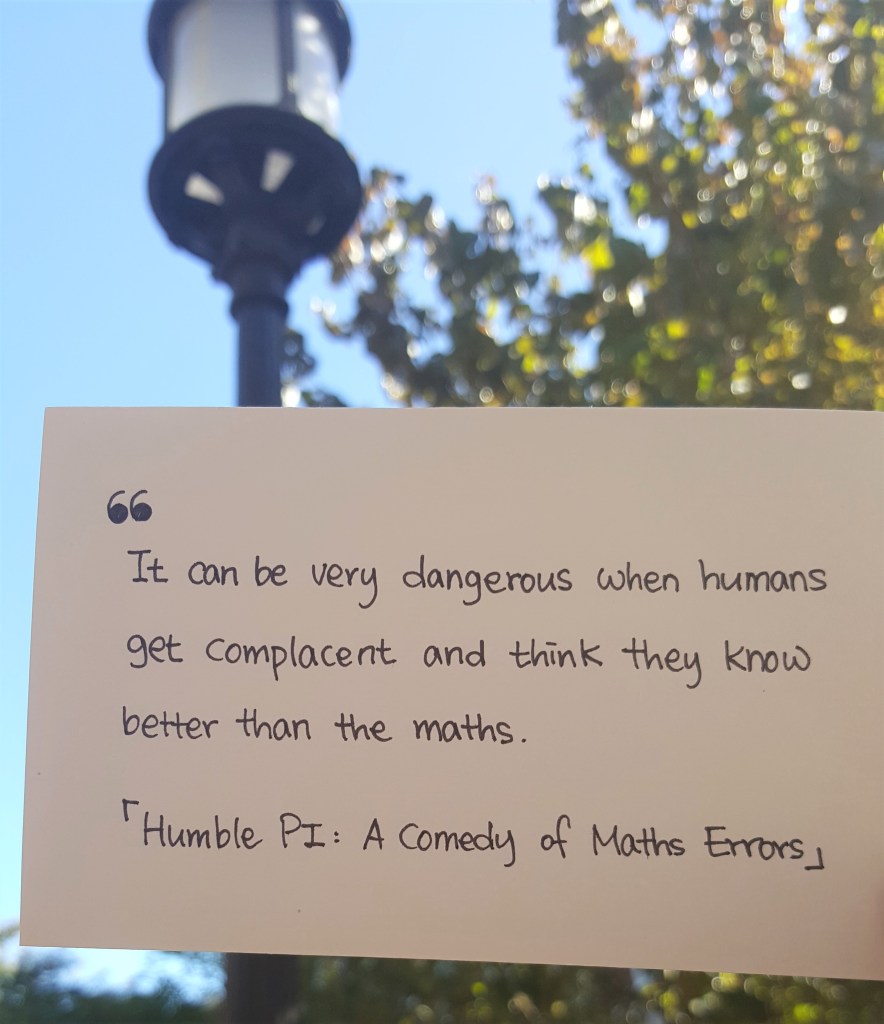
“If a new system is implemented, humans can be very resourceful when finding new ways to make mistakes. It can be very dangerous when humans get complacent and think they know better than the maths.

[Humble PI: A Comedy of Maths Errors, Matt Parker]

If someone has accumulated knowledge based on a lot of experiences in a particular subject, we call her/him an expert. When a paradigm is shifted or a new knowledge system comes, we often follow existing experts’ opinions without a doubt. I don’t underestimate the important role of existing experts to show a vivid and clear vision for the new age, stemming from appropriate heuristics. However, sometimes their knowledge and experiences are obsolete. For example, the experts about the Ptolemaic system lost their power in the age of the Copernican system. When a new system of knowledge is coming, what can we do? Should we stick to old ways of doing things?

Our model based on previous experiences is suitable for predicting similar tasks but vulnerable to predict rare events. The model (or knowledge) based on mathematics, however, is still robust to an extreme case or a rapid change. Moreover, our knowledge from experiences seems to be fragmentary and unconnected for understanding a big complex system while mathematics can describe it more effectively and clearly. Hence, when you do something totally new, please think one more time before act on instinct or previous experience. Human keeps on making the same mistakes over and over again. Also, previous experience may not predict something new effectively. Instead, find evidence (or facts), do mathematical thinking (or making mathematical model) with them, and take the simplest way to understand without logic fallacy. I cannot say such mathematical thinking is the best (or the only) way to be right. Rather, mathematical thinking is the way not to be wrong.

Searching for Average Man

humble pi average

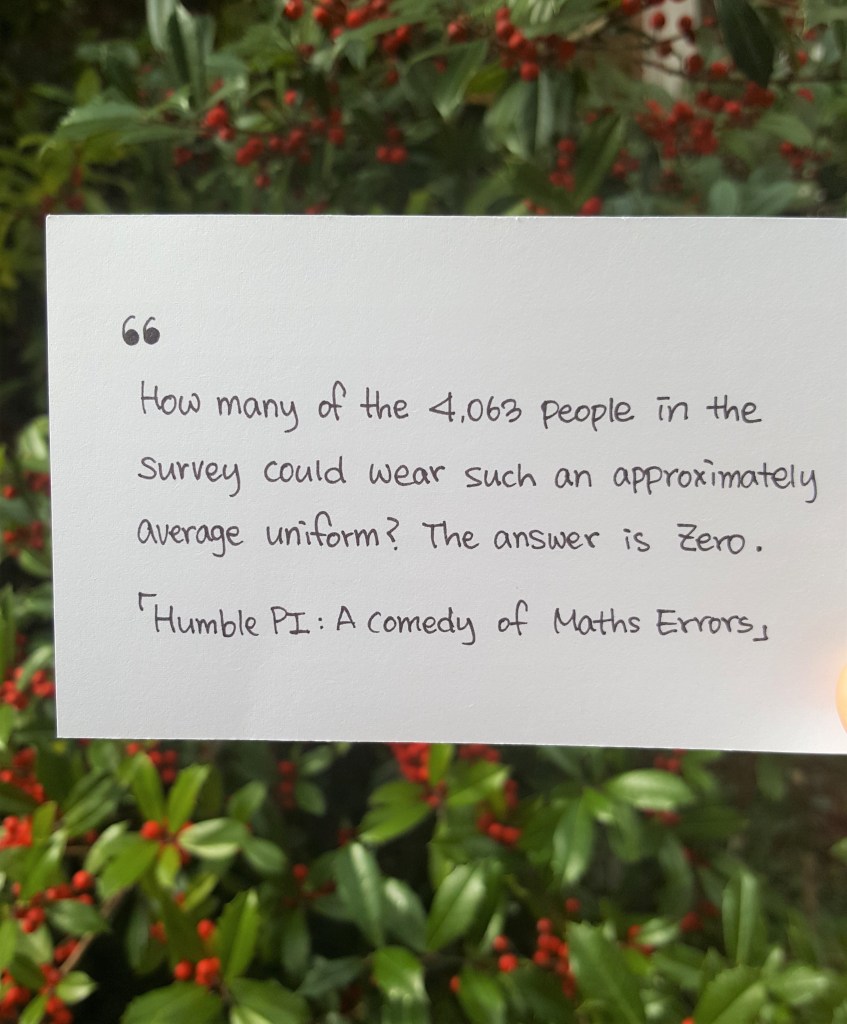
“How many of the 4,063 people in the survey could wear such an approximately average uniform? The answer is zero.”

[Humble PI: A Comedy of Maths Errors, Matt Parker]

An average is the simplest statistic to measure the characteristics of data; just add up all the values of data and divide it by the number of data. This simple calculation has been widely used to set a standard for assessment such as average earning, average height, or average life expectancy. Statistically, the average is vulnerable to an outlier. Moreover, the average does not give us information about the distribution of data. That’s why statistical analysis usually provides the average and its standard deviation for sample data. Still, these two values are not enough to represent data due to a large variability (e.g. using any values of average and of standard deviation, we can draw a dinosaur silhouette). Hence, you should choose the right statistic for a clear understanding of the data.

Then, can we say the average is the best number for representing our group or society? The answer is NO. The average man is not a real person and also not a standard for us. In the book “The End of Average“, the author, Todd Rose, showed the failure of our education based on the statistical average. An average is just a number calculated without any context. So, we don’t need to set the average as our standard for success or failure. The annual performance rate cannot measure your success rate in your life. The academic GPA cannot give you the grade of your life. Please don’t follow a phantom of the average. Keep pace with your own plan in your life. After being an outlier in success, please tell us your amazing story, not just give a number.

Please Give Math More Time to Pick up the Pieces

humble pi

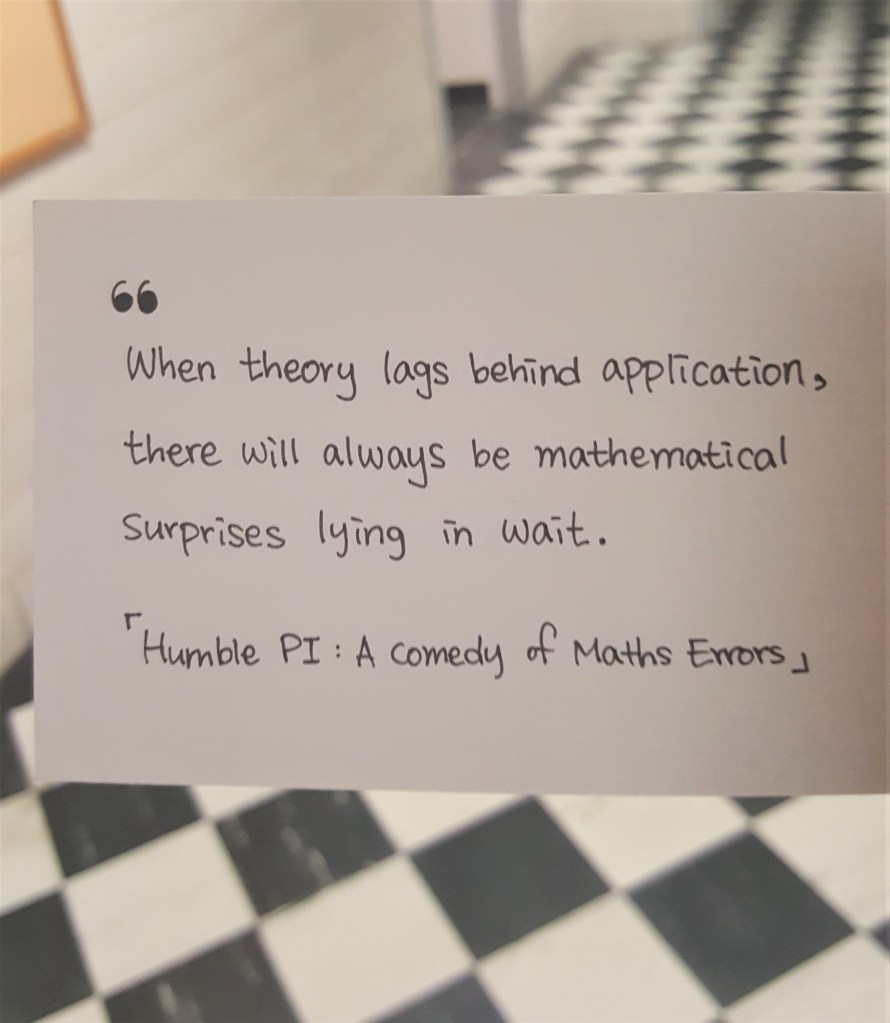
“We make things beyond what we understand, and we always have done. … When theory lags behind application, there will always be mathematical surprises lying in wait.”

[Humble PI: A Comedy of Maths Errors, Matt Parker]

In human history (specifically engineering and technology), many successful achievements have shown their effectiveness without proven scientific theories or rigorous mathematics. For example, first flying to the moon in 1969 was achieved with little knowledge of rocket science, aerodynamics, and astrophysics. Sometimes, we called such achievements “the greatest challenge for humans.” However, the word “challenge” here implies that we do not know a mechanism or theory well. I don’t want to underestimate such a challenge but we have experienced that applications without coherent theories may lead to a catastrophic disaster.

Then, in data science, when is the right time to adopt a new model? Should we wait until we understand all theories and mechanisms and prove them all by mathematics? It may be too late. So we should decide the right time by ourselves but we always keep in mind the negative effect when the introduced model fails. So, we try to quantify uncertainties of the model (or our decision) and estimate a probable disaster as insurance companies do. It is much robust thinking rather than efficient thinking. It may lead to slow progress and more cost but it can give us a second chance to correct the model when the model fails. So, if you don’t have rigorous mathematical support, please think uncertainty and make your model robust. Moreover, when you decide something without evidence in your life, please make your decision robust, too.

[Wrap up] Book Review: How Not to Be Wrong: The Power of Mathematical Thinking

We need to focus on the book title: How not to be wrong. Why did the author, Jordan Ellenberg, not say like: How to be right? This is because mathematical thinking is not the fruit of the Tree of Knowledge. Even though we equipped ourselves with concrete mathematical thinking, we cannot get the right answer to some problems we faced in the world. However, mathematical thinking helps us to correct our view based on a popular misconception and prejudice and to understand the structure of the world more clearly.

In this book, the author presents several mathematical misconceptions (more focused on statistics) that make the wrong decision and prediction, and show how mathematical thinking can overcome such kinds of obstacles. Since mathematical thinking is the extension of common sense by other means, the author said that we need more math majors for non-mathematician such as more math majors for non-mathematician such as math major doctors, high school teachers, CEOs, and politicians.

The following links are some quotations from the book with my thoughts.

(1) Do You Want to Be a Nonlinear Thinker?

(2) The Past is in the Past: the Law of Large Numbers

(3) Improbable Things Happen All the Time

(4) Can We Predict our Future in Chaos?

(5) Make Your Problem Harder!

(6) The Triumph of Mediocrity: Do not Stumble on Your Success

(7) Everything is Connected but Not Correlated

(8) When You Meet a Mathematical Genius