Everything is Connected but Not Correlated

How not to be wrong

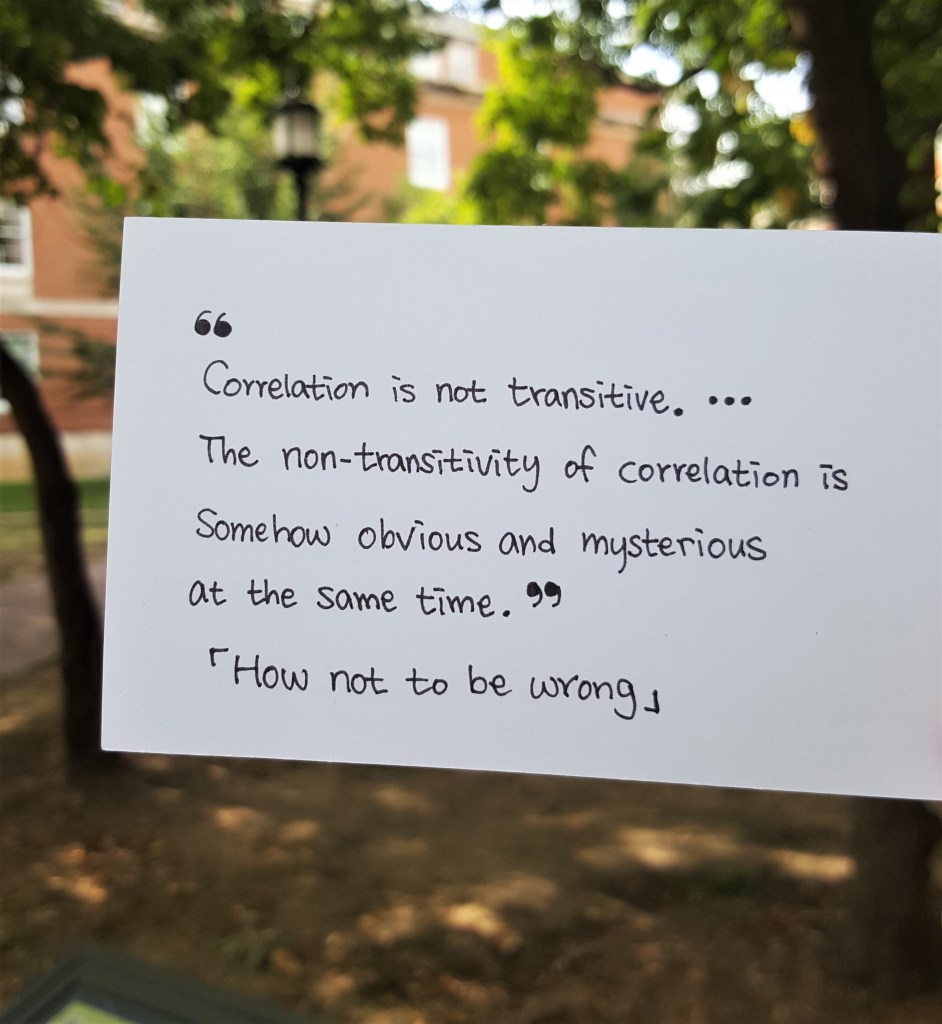
“Correlation is not transitive. … The non-transitivity of correlation is somehow obvious and mysterious at the same time.”

[How not to be wrong, Jordan Ellenberg]

In Hollywood, the Bacon Number of an actress/actor represents the closest connectivity to the actor, Keven Bacon through movies. Surprisingly, we observed that almost all the actresses/actors can be connected to Keven Bacon within six steps, called this: “Six Degrees of Separation” or “Small World.” This concept originally stems from “Erdős Number” in mathematics and science research, representing a collaborative distance to the mathematician, Paul Erdős. (My Erdős number is 4 by-the-way). What a small world and we feel that everybody is connected!

Sometimes, we confuse a correlation with a connection (or relation). A correlation is not transitive. Even though A and B are strongly correlated and B and C are also correlated, nobody can guarantee that A and C are correlated. However, we often think that there should be a correlation between A and C because we get used to syllogistic reasoning. Moreover, when we mixed up with causality, correlation, and relation, it’s a disaster. So, please do not make any transitivity for mutually correlated data. Also, we keep in mind that uncorrelated data can have a relationship with each other. We, you and I, are connected in the small world but we may not (or may) be correlated with each other.
The Triumph of Mediocrity: Do not Stumble on Your Success

Triumph of Mediocrity

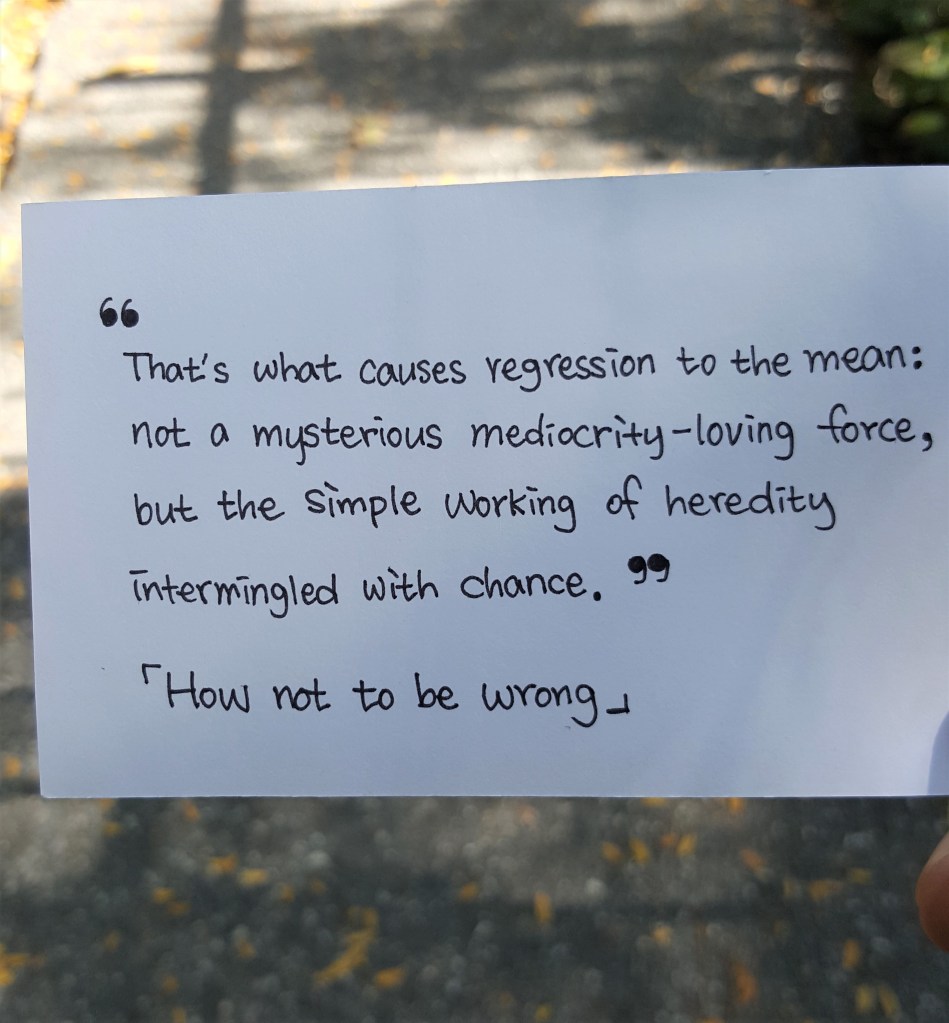
“That’s what causes regression to the mean: not a mysterious mediocrity-loving force, but the simple working of heredity intermingled with chance.”

[How not to be wrong, Jordan Ellenberg]

At the beginning of the month, I check the number of visitors and views on my blog and say: “What? Too many people come in! Then, my blog is ON PACE to break my monthly record!!” I am really excited about this shock rise. At the end of the month, my eyes widen in surprise because the average number of people visited, no new record (Sigh). This shows “The Triumph of Mediocrity.” Some data intertwined with deterministic factors and uncertainties show a tendency to regress to the mean.

This simple mathematical observation gives a lesson about how to live. There is no (deterministic) equation of success. Even if it exists, it has too many uncertainties so we cannot solve this equation. When you achieved something that you want, this success does not only stem from your skills, abilities, intelligence, and effort. Rather, uncertainties (many people call this “luck”) may drive your way to success. Just when you think that you find the equation of the success, your next try may fail and you will be back to the mean – we call this “Sophomore Slump.” So please be humble. please do not stumble on your success. Also, if you did your best but failed, please try one more, the triumph of mediocrity may take you to the success.

Make Your Problem Harder!

How not to be wrong

“Instead, we turn to the other strategy, which is the one Birbier used: make the problem harder. That doesn’t sound promising. But when it works, it works like a charm.”

[How not to be wrong, Jordan Ellenberg]

When your friend was struggling with a difficult problem, we often said: “Don’t make it complex, just start with a simple problem”. This is because we have experienced that this simplification provides some clues for solving the difficult problem. This is what mathematicians actually do every day. When proving some statements, they start from the simplest case and expand it to the target problem. However, sometimes, making the problem harder suggests a simple alternative way to solve your real problems effectively.

Many data scientists have focused only on reducing the number of features to make a data-driven model simper. However, this approach does not always give the simplest model. The projection onto the low-dimension (fewer features) may make the data structure more complicated, leading to a failure of spotting the hidden pattern. Hence, sometimes, they need to increase features to make a model simpler (because of more data, more simple). This alternative thinking (adding more features) embodies the trade-off between a simpler model with many features and a complicated model with few features.