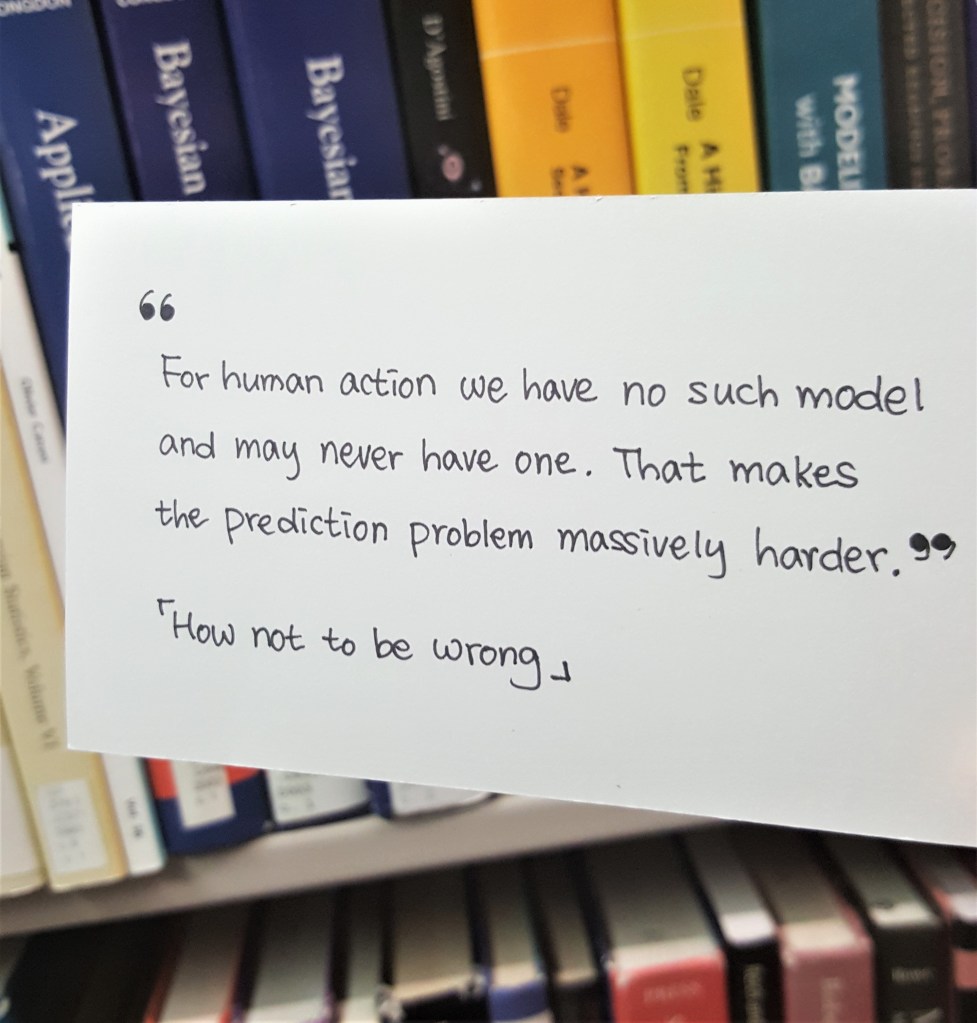
“For human action we have no such model and may never have one. That makes the prediction problem massively harder.”
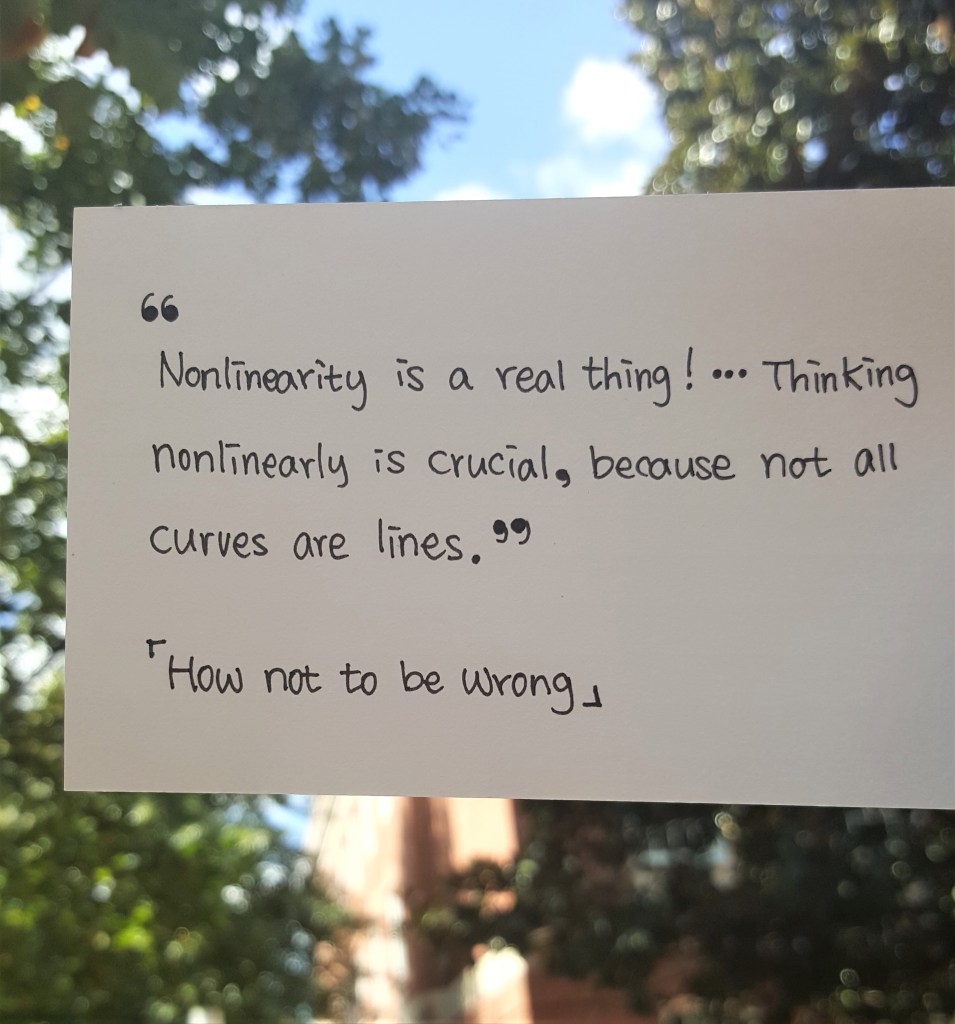
[How not to be wrong, Jordan Ellenberg]
In the weather, the very tiny scale of energy at a certain location can change the global outcome dramatically – we called this chaos. Edward Lorenz discovered this and wrote: “if the theory were correct, one flap of a sea gull’s wing would be enough to alter the course of the weather forever”. Even though we have an accurate mathematical model (or a data-driven model) for the weather forecast with tons of measured data, we can make only a short-range prediction.
Our behaviors in society are much more chaotic than the weather, leading to a failure of prediction of future outcomes. Moreover, we have no mathematical model to describe our behaviors effectively. Hence, it is really hard (or impossible) to find “right” causation from the massive data. In this chaotic system, we should keep in mind the followings: (1) don’t make any causation from your success (rather, say, just “lucky”); (2) don’t follow others’ successes (a tiny different condition makes a totally different outcome); (3) don’t prejudge the situation using “common sense” (no one can predict the outcome).
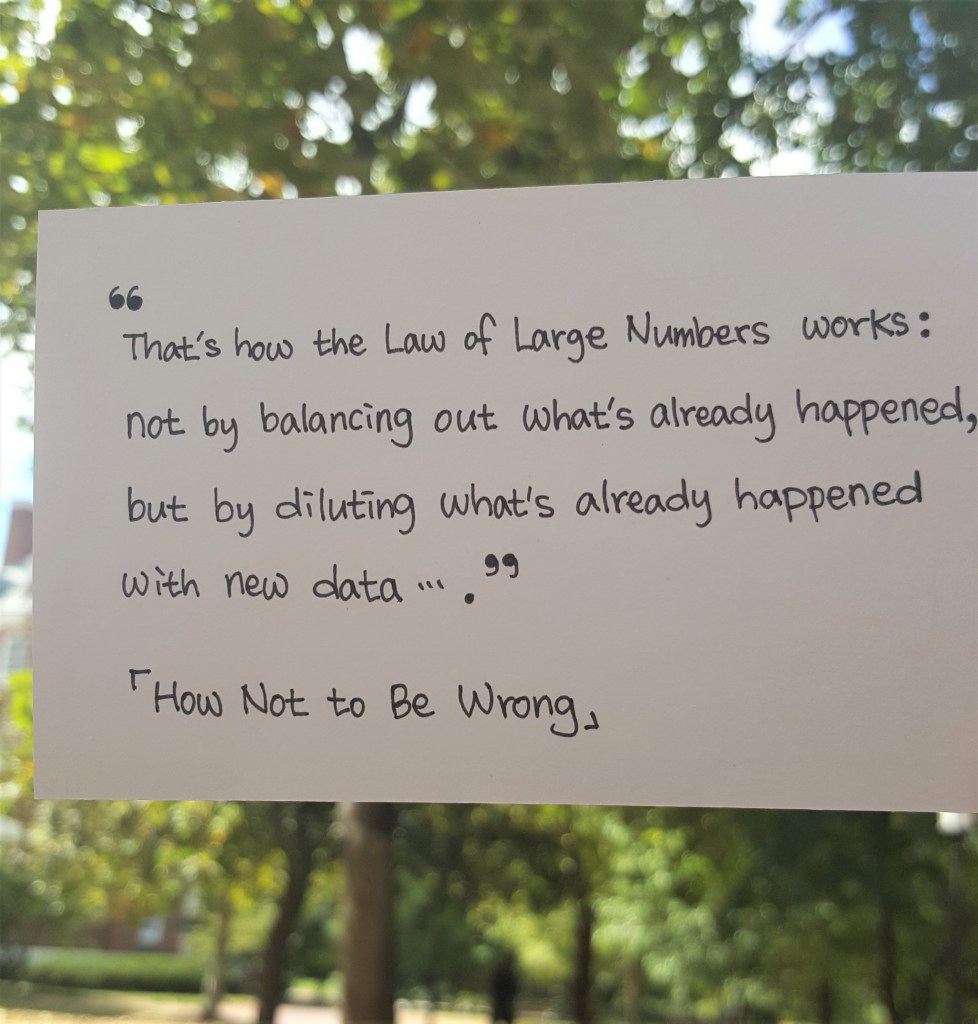
 Everybody makes DATA